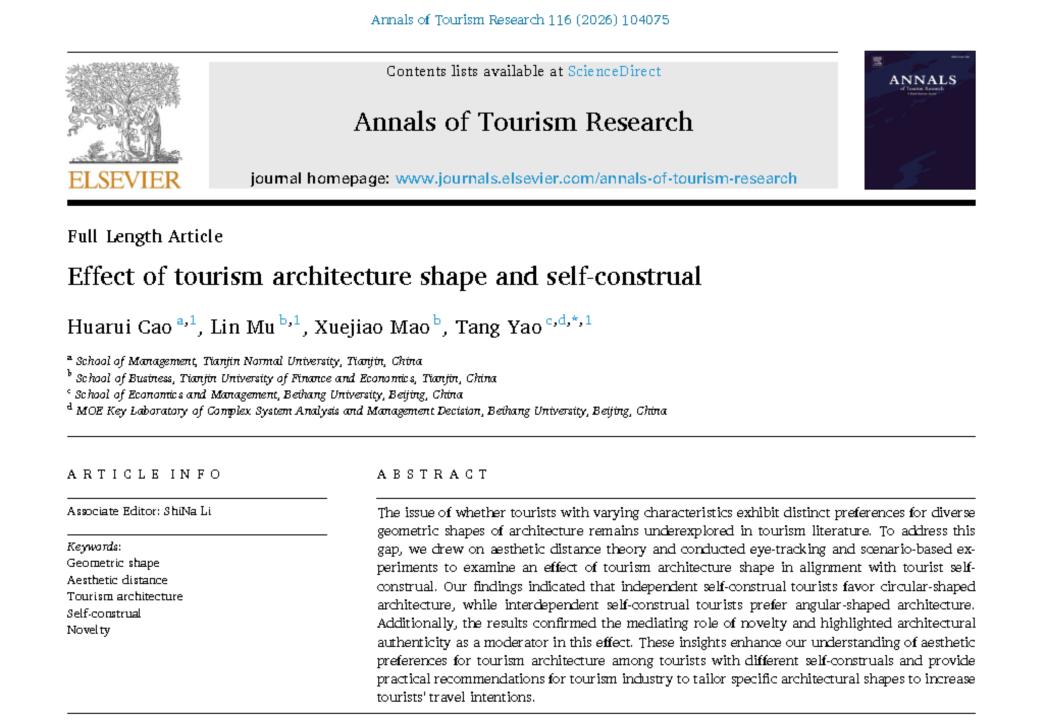
On December 2, 2025, an interdisciplinary research team led by Associate Professor Tang Yao (sole corresponding author) from the School of Economics and Management, Beihang University, published an academic paper titled "Effect of tourism architecture shape and self-construal" online in Annals of Tourism Research, a top international journal in the field of tourism management. This marks another significant achievement of Associate Professor Tang Yao's team in publishing in a top international journal, following their important research results published earlier this year in Tourism Management, another flagship journal in the tourism management field. The consecutive publications in two top-tier journals in tourism management within a short period not only highlight the team's continuous in-depth research and innovative breakthroughs in the direction of tourism service management but also fully demonstrate their profound academic accumulation, strong scientific research capabilities, and significant international academic influence.
Notably, this important research achievement closely responds to the national strategy proposed in the "Recommendations of the Communist Party of China Central Committee on Formulating the 15th Five-Year Plan for National Economic and Social Development" adopted at the Fourth Plenary Session of the 20th Central Committee of the Communist Party of China, which emphasizes "promoting the construction of a strong tourism country, improving the convenience and internationalization of inbound tourism, and empowering economic and social development through culture." Focusing on the core aesthetic issues in the development of cross-cultural tourism, the research provides a new theoretical perspective and key practical guidance for conducting Sino-foreign cross-cultural exchange activities.
Addressing Cross-Cultural Tourism Aesthetic Dilemmas and Revealing Preference Laws of Tourism Architecture Shapes
With the acceleration of globalization, cross-cultural tourism has become an important driving force for international exchanges and the growth of the cultural and tourism economy. However, current academic research on the preference laws of tourists from different cultural backgrounds for the geometric shapes of tourism architecture is still relatively scarce. This theoretical gap restricts the precise design of tourism destinations and the improvement of international service capabilities.
To fill this research gap, the team innovatively drew on the "Aesthetic Distance Theory" to explore the intrinsic connection between self-construal and preferences for tourism architecture shapes. Through research, the team found that in tourism contexts, tourists' core demand is to escape familiar daily scenarios by immersing themselves in non-routine environments, and "novelty seeking" serves as a key motivation driving tourism behavior. Based on this, the team systematically verified conclusions through four sub-studies: in tourism settings, individuals with an independent self-construal show a stronger preference for circular tourism architecture, while those with an interdependent self-construal prefer angular tourism architecture. Among them, "perceived novelty" plays a mediating role in the formation of these preferences, and architectural "authenticity" (original architecture vs. simulated architecture) acts as a moderator—original architecture further strengthens this preference matching effect.
Verifying Scientific Conclusions through Multiple Methods, Highlighting Dual Theoretical and Practical Values
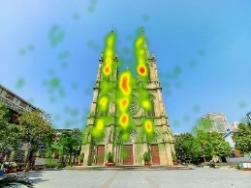
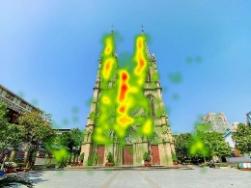
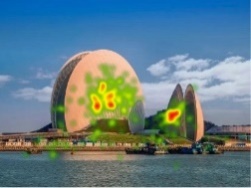
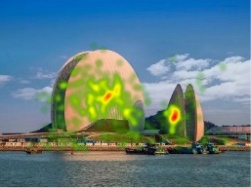
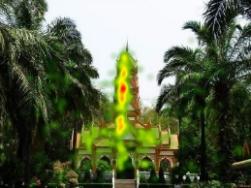
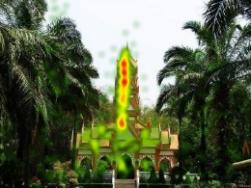
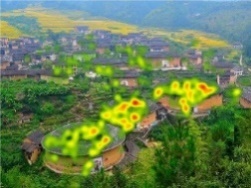
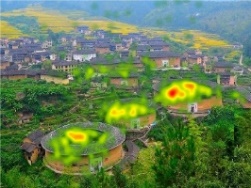
To ensure the scientific validity and generalizability of the research conclusions, the team adopted a multi-method research design combining "eye-tracking experiments + scenario-based simulation experiments": a rigorous eye-tracking experiment was conducted to capture the laws of tourists' visual attention allocation, directly reflecting differences in attention to buildings of different shapes; meanwhile, three rigorous scenario-based simulation experiments were carried out, covering participants from diverse cultural backgrounds, ultimately verifying the effectiveness and cross-cultural applicability of the theoretical model.
|
Angular images |
|
Circular images |
|
Independent self-construal |
Interdependent self-construal |
|
Independent self-construal |
Interdependent self-construal |
|
|
|
|
|
|
|
|
|
|
|
|
From a theoretical perspective, this research is the first to reveal the matching effect between the aesthetics of tourism architecture shapes and tourists' self-construal, clarifying the mediating role of novelty and the moderating role of architectural authenticity. It fills the research gap in "psychological mechanisms and gaze effects" of the Aesthetic Distance Theory in the tourism field, further enriches the theoretical system of cross-cultural tourism aesthetics, and provides an important theoretical reference for subsequent related studies.
From a practical perspective, the research findings provide precise guidance for the development of the tourism industry: tourism destinations can tailor the design of tourism architecture shapes and optimize the scenic visual symbol system according to the self-construal characteristics of target audiences (such as differences in self-construal among tourists from different countries and cultural backgrounds); at the same time, they can accurately push personalized tourism information in combination with the authenticity of buildings, effectively improving tourists' aesthetic experience and travel intentions. This helps tourism destinations achieve "precise customer acquisition" and "experience upgrading," providing a new practical path for promoting the construction of a strong tourism country.
Recognition from Top Journal and Academic Award
Annals of Tourism Research is widely recognized as one of the three authoritative top journals in the global tourism management field (the other two being Tourism Management and Journal of Travel Research). Its academic status and influence are fully confirmed by multiple international authoritative indicators, serving as a core benchmark for the quality of academic achievements in this field. The journal maintains a top global ranking: with an impact factor of 10.4 in 2024 and a five-year composite impact factor as high as 11.2, it has long been listed as a Q1 TOP journal in the Management category of the Chinese Academy of Sciences; the Association of Business Schools (AJG/ABS) has rated it as a four-star journal, the highest level, demonstrating the high recognition of its academic quality by the international academic community. In the Web of Science (JCR) classification, the journal performs exceptionally well—it ranks in the top 2% of Q1 in the "Hospitality, Leisure, Sport & Tourism" discipline (ranking 3/139, percentile 98.2%) and even enters the top 0.2% of Q1 in the "Sociology" discipline (ranking 1/217, percentile 99.8%), fully reflecting its top competitiveness in interdisciplinary fields. In addition, its key Elsevier evaluation indicators are outstanding: a CiteScore of 19.1, an SJR index of 3.447, and an SNIP index of 2.667, all far exceeding those of most journals in the same field, indicating that the published papers have significantly higher average citations and academic communication power, with global academic influence.
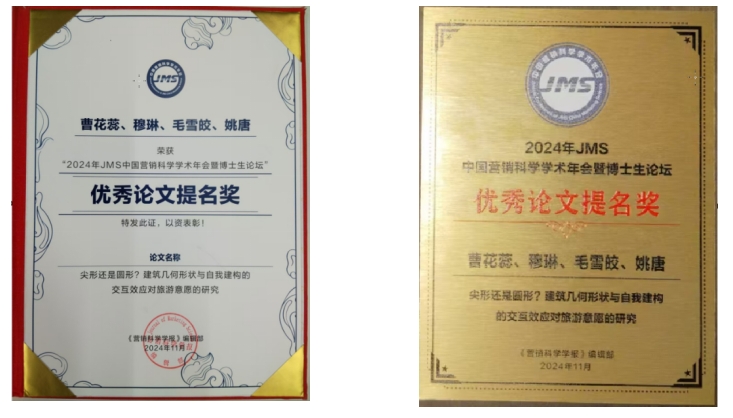
Notably, the paper also received a Nomination Award for Excellent Paper at the 2024 China Marketing Science (JMS) Annual Conference. As a top academic conference in the marketing field guided by the Department of Management Science of the National Natural Science Foundation of China and hosted by the Journal of Marketing Science, the 2024 JMS Conference received 216 papers for presentation, and only 15 excellent papers were selected (including 1 first prize, 2 second prizes, 6 third prizes, and 6 nomination awards), with an award rate of only 6.94%. This award further confirms the academic value and innovation of the research in the interdisciplinary field of marketing and tourism in China.
The full text of the paper can be accessed via the link:
https://www.sciencedirect.com/science/article/abs/pii/S0160738325001811