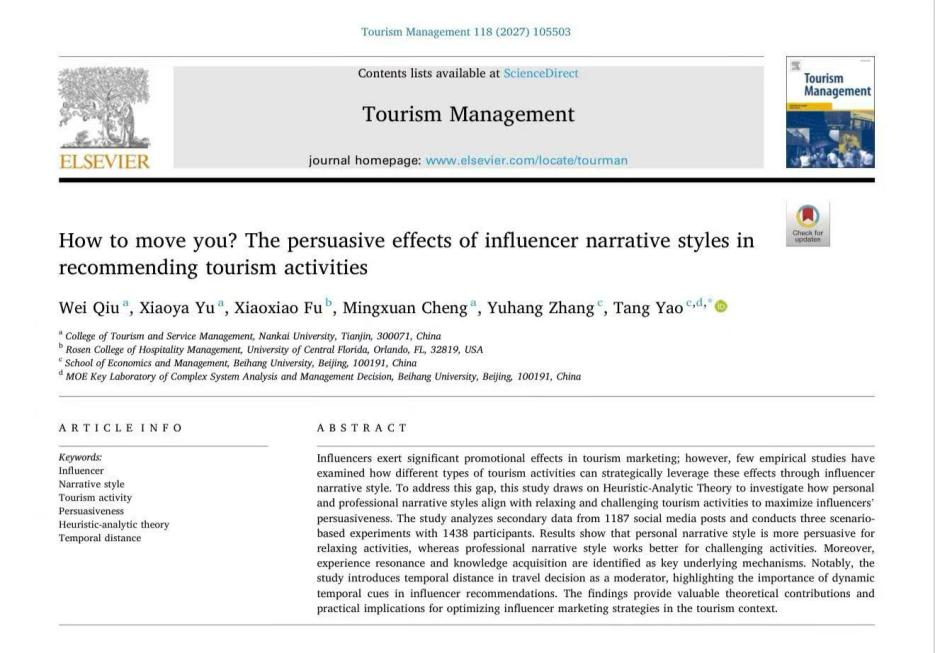
Recently, an internationally cross‑institutional research team led by Associate Professor Tang Yao (corresponding author) from the School of Economics and Management, Beihang University, including Associate Professor Wei Qiu from Nankai University, Associate Professor Xiaoxiao Fu from the University of Central Florida, USA, and Ph.D. candidate Yuhang Zhang from SEM, Beihang University, has published the paper “How to move you? The persuasive effects of influencer narrative styles in recommending tourism activities” online in Tourism Management, one of the world’s three leading academic journals in tourism management.
The 15th Five‑Year Plan Outline for National Economic and Social Development of the People’s Republic of China clearly states the goals to “advance the building of a tourism‑powerful nation, further integrate culture and tourism, enrich high‑quality tourism product supply, foster new drivers for the tourism industry, unlock tourism consumption potential, promote the in‑depth integration of digital technologies with the cultural‑tourism sector, and give full play to new carriers such as social media in tourism promotion”. Against the policy backdrop of national‑driven high‑quality development of digital cultural‑tourism industries, social‑media influencers (cultural‑tourism content creators) have become vital communication agents for destination promotion and stimulating public tourism consumption willingness. Nevertheless, prominent pain points persist in current cultural‑tourism communication practices: mismatches between creator content and tourism‑product attributes are commonplace, resulting in uneven communication performance. Solid empirical evidence is still lacking on how different narrative approaches fit diverse tourism offerings. Centering on the high‑quality‑development objectives for the tourism sector set out in the 15th Five‑Year Plan, this study addresses real‑world issues in social‑media‑based cultural‑tourism communication. It provides theoretical underpinnings and implementable practical solutions for better leveraging new‑media promotion tools, enabling precise destination marketing, and upgrading cultural‑tourism communication content.
Rooted in the Heuristic‑Analytic Theory, this study draws on social‑media secondary data alongside three scenario‑based experiments for empirical analysis. It identifies the matching effect between influencer narrative styles and tourism‑activity types, and uncovers relevant mediating mechanisms and contextual boundary conditions. Empirical results demonstrate that the personal narrative style effectively evokes tourists’ emotional resonance and generates stronger persuasive outcomes for relaxing tourism activities. By contrast, the professional narrative style enables audiences to acquire objective information and form rational perceptions, thus boosting content persuasiveness for challenging tourism activities. Incorporating recommendation timing into the analytical framework, the research clarifies matching strategies for influencer marketing under dynamic scenarios. Challenging the prevalent industry assumption that “greater influencer clout guarantees higher persuasiveness”, this study confirms that persuasive power hinges on the precise alignment between narrative style and tourism‑activity attributes. The findings enrich theoretical research on influencer marketing and tourist information processing, and deliver practical references for tourism destinations to attract targeted visitors and for cultural‑tourism creators to refine content production.
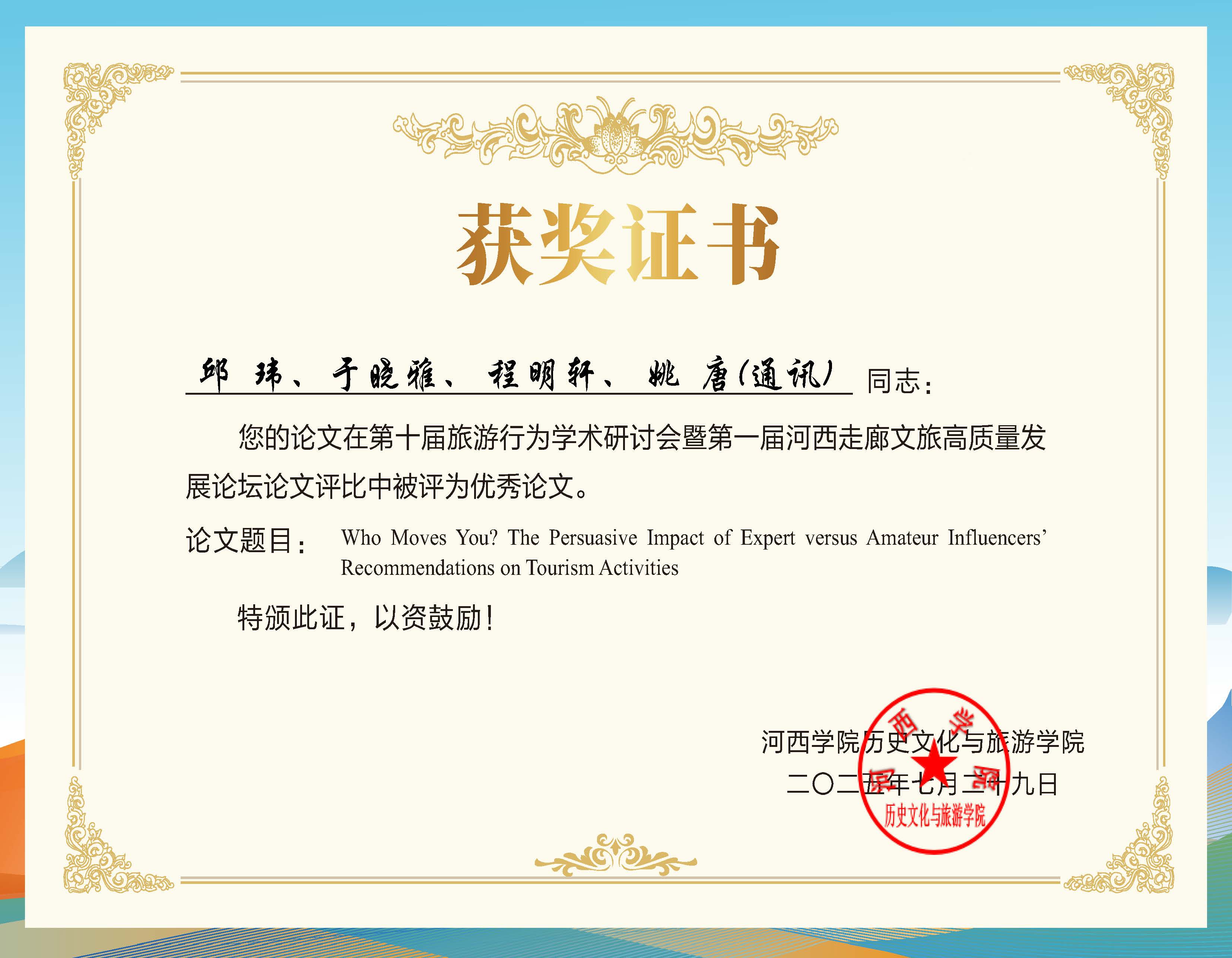
This paper was previously awarded the Excellent Paper Prize at the 10th Tourism Behavior Academic Symposium & the 1st Hexi‑Corridor Cultural‑Tourism High‑Quality‑Development Forum in 2025.
The publication of this paper further demonstrates the international academic strength of Associate Professor Tang Yao’s research team at the School of Economics and Management, Beihang University, in digital cultural‑tourism and tourism new‑media marketing. Building on a series of prior publications in leading tourism journals including Tourism Management and Annals of Tourism Research, the team continues to produce high‑quality indigenous empirical insights addressing practical challenges within the cultural‑tourism industry. It offers important theoretical support and practical references for implementing the 15th Five‑Year Plan initiatives and advancing the construction of a tourism‑powerful nation through digital approaches.
Journal Introduction
Tourism Management ranks among the world’s three most authoritative academic journals in tourism management, enjoying outstanding academic influence and industry recognition across tourism‑related disciplines. It holds multiple prestigious academic credentials: ABS (AJG) 4‑star journal, Federation of Management Societies of China (FMS) A‑class journal, with its latest 2025 Journal Impact Factor reaching 14.5.
Paper link: https://www.sciencedirect.com/science/article/pii/S0261517726001135