From November 2 to 5, 2026, the 39th ACM Symposium on User Interface Software and Technology (ACM UIST 2026) — widely recognized as one of the world's leading academic conferences in human-computer interaction (HCI) — was held in Detroit, Michigan, USA. A research paper by the team of Associate Professor Zhe Chen of the School of Economics and Management (SEM) at Beihang University, with Beihang University as the first affiliation and Chen as corresponding author, was accepted and published online: "PrejSense: Non-intrusive Gaze-Informed Prediction of Implicit Prejudice Against Machine for Proactive Interface Adaptation." As arranged by the conference, the team presented the work through a video presentation. The publication marks SEM's first-ever paper at ACM UIST, a Class A conference recommended by the China Computer Federation (CCF).
1. Research and Findings
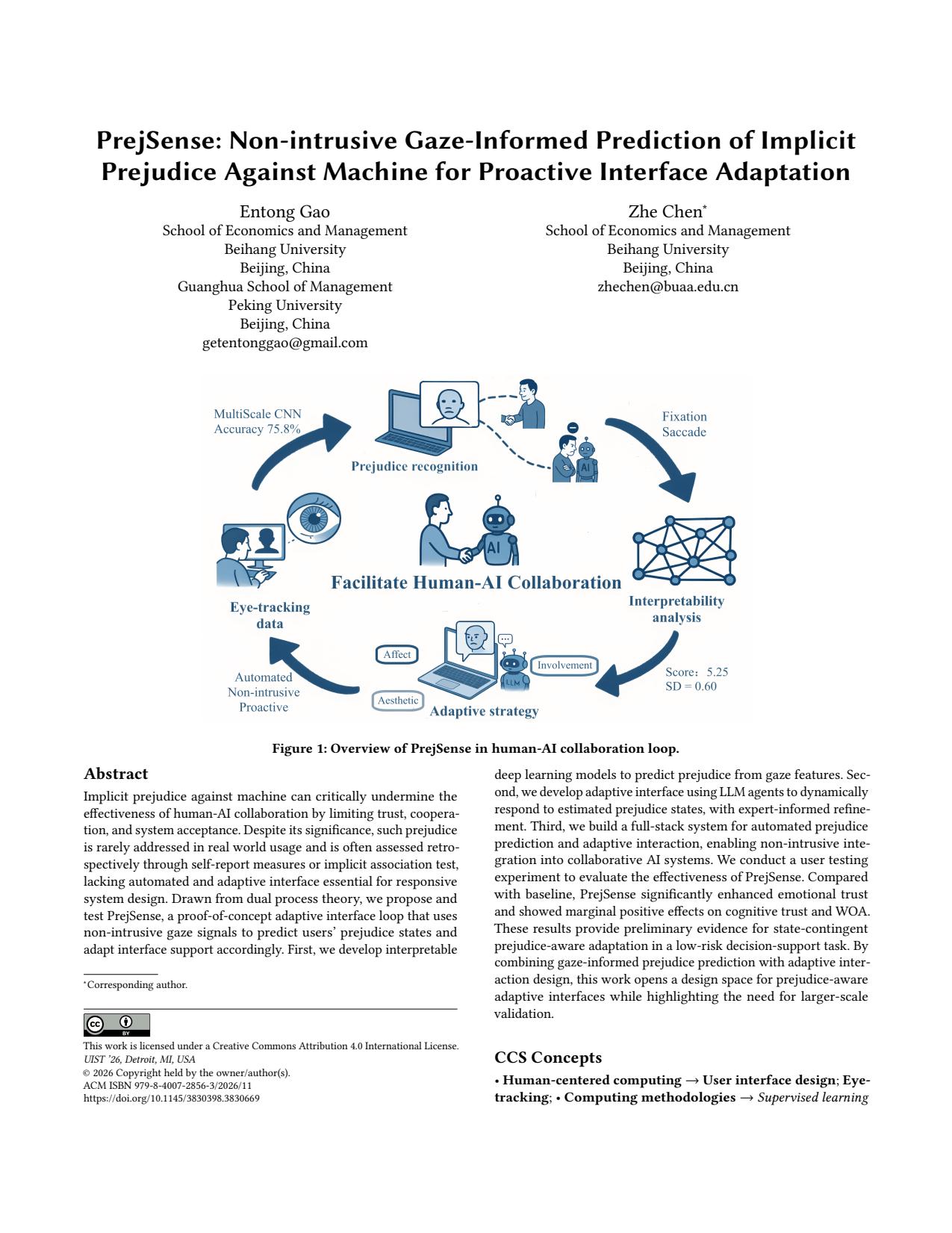
People's implicit prejudice against machines can lead them to over-rely on or blindly reject AI advice, undermining the effectiveness of human-AI collaboration. Existing measures, however — retrospective questionnaires and the Implicit Association Test — are difficult to embed in natural interaction. To address this gap, the team developed PrejSense, a prejudice-aware adaptive interaction system built around a closed loop of "gaze sensing - prejudice prediction - interface adaptation." An interpretable deep-learning model predicts users' implicit prejudice from eye-movement features with 75.8% accuracy; large language model (LLM) agents, working with an expert focus group, generate personalized interaction strategies; and an ordinary webcam enables non-intrusive, real-time sensing with an end-to-end latency of just 68.7 milliseconds. User experiments show that PrejSense significantly improves users' emotional trust and their adoption of AI advice — the Weight on Advice (WOA) rising from 0.690 to 0.842 — effectively alleviating algorithm aversion and opening up a new design space for prejudice-aware adaptive interfaces.
Founded in 1988, ACM UIST (ACM Symposium on User Interface Software and Technology) is one of the oldest and most influential leading conferences in HCI and is ranked Class A by the China Computer Federation (CCF). With a long-standing focus on novel interaction techniques and user-interface software and technology, it is widely regarded as a bellwether of interaction innovation and brings together leading researchers from academia and industry worldwide.
2. A Series of Breakthroughs Led by Undergraduates
The paper lists Beihang University as the first affiliation, with Associate Professor Zhe Chen as corresponding author and an outstanding undergraduate student of SEM as first author. It is one of a series of achievements in intelligent-interaction research that Chen and her undergraduate students have produced at CCF Class A journals and conferences. Earlier work from the team on intelligent voice interaction was published at ACM CHI 2026 (the ACM Conference on Human Factors in Computing Systems) and in the International Journal of Human-Computer Studies (IJHCS). All three papers are SEM's first publications in their respective top HCI journals and conferences, marking a significant breakthrough for the school in CCF Class A HCI venues.
These achievements exemplify SEM's efforts — guided by the discipline of Management Science and Engineering — to integrate management with engineering and technology, especially artificial intelligence, and to cultivate students' cutting-edge research capabilities in human-AI collaboration and interdisciplinary, versatile talent. In this research, undergraduates took part in the entire pipeline, from theoretical modeling and experimental design to deep-learning training and system development. The work reflects the distinctive strengths of Beihang SEM's undergraduate education: a solid foundation in mathematics and the sciences, rigorous professional knowledge, a command of frontier engineering technologies such as artificial intelligence, the ability to analyze intelligent systems, and the capacity to identify and solve complex problems in real-world settings — setting an exemplary model for the school's cultivation of top innovative undergraduates.
Corresponding Author
Zhe Chen is an Associate Professor and master's supervisor at SEM, Beihang University, and Head of the Department of Industrial Engineering and Management Science. Her research focuses on multimodal natural interaction of intelligent systems.
Email: zhechen@buaa.edu.cn
Paper link: https://doi.org/10.1145/3830398.3830669